


ICU Trials by ClinCalc
4.616.00 Reviews
App Specs
- Version
- 2026.07
- Updated On
- License
- $4.99
- Downloads
- 10,000+
- Developer
- ClinCalc LLC
- Categories
- Medical
- Platform
- Android, iOS
Screenshots
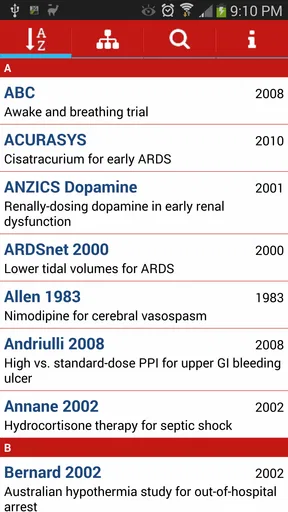
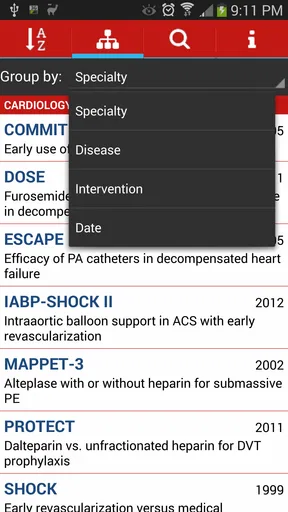
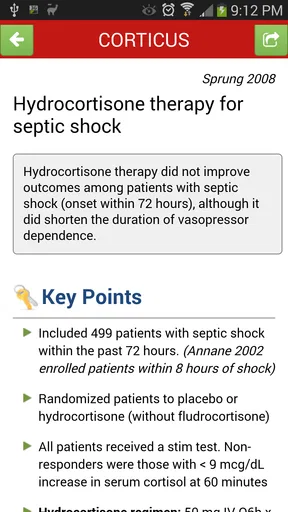
 Analysis by AppCompare
When I need to refresh my memory on a landmark intensive-care study, I do not always want to open a browser, sort through search results, and reconstruct the clinical context from several pages. ICU Trials takes a much narrower approach: it puts summaries of important critical-care trials into a focused medical reference app. That limited purpose is also its main appeal. It is not trying to be a general medical encyclopedia, a patient symptom checker, or a replacement for formal clinical guidance.
Developed by ClinCalc LLC, this paid Medical app is aimed at people who already understand the language of intensive care and want a compact way to revisit evidence. I found the concept most useful when studying, preparing for a discussion, or checking the broad conclusion of a familiar trial before going back to the original publication. The app costs $4.99, carries an Everyone age rating, and has reached over 10K installs. Its average rating is 4.6 from more than 200 ratings, which fits my impression that it serves a specific audience well rather than attempting to be useful to everyone.
How ICU Trials fits into real clinical reading
The first thing to understand is the app’s role. It is a trial-summary reference, not a bedside decision engine. That distinction matters because a concise summary can help me remember what a study investigated and why it mattered, but it cannot replace reading the paper, checking current guidelines, or considering the individual patient in front of me.
For a medical student, resident, fellow, nurse, pharmacist, or clinician working around critical care, the format can be more practical than keeping a collection of browser tabs open. A focused list of landmark studies gives me a starting point for evidence-based revision. Instead of searching broadly for “important ICU trials,” I can go directly to the app and use it as a study companion.
I also like the way this kind of tool supports spaced review. A useful routine is to choose one familiar topic, read the summary without looking at notes, and then write down what I remember about the population, intervention, comparison, and main result. That turns the app from passive reading into an active recall tool. The important trade-off is that the app is valuable only if I already know enough to question and interpret what I am reading.
Someone looking for medication dosing, a diagnostic calculator, patient education, or emergency instructions should skip this purchase. The narrow scope is not a flaw for its intended audience, but it makes the app a poor match for general health questions. A patient or family member would likely find a plain-language medical resource more appropriate and less intimidating.
What makes the focused format useful
In my experience, the strongest benefit is reduced searching. General web searches often mix original research, commentary, institutional pages, and outdated summaries. Even when the information is accurate, the process can be slow and distracting. A dedicated trial reference gives me a cleaner route to the evidence topics I am trying to review.
Worth Reading Before You Choose

Flipboard Shows What News Apps Must Do Beyond the Feed

Switching to Android Auto Means Rethinking Your Driving Routine

Google Calendar Makes a Crowded Week Easier to Manage

Ludo King Makes the Most of the Minutes Between Plans

Baby Panda World Brings Quick Play to Modern Phones, but Its Game Library Feels Busy

ESPN’s Live Game View Makes Following Close Games Easier
That does not mean every short session is automatically fast. The perceived speed depends on what I am trying to do. Opening a reference entry for a quick reminder feels more efficient than researching from scratch. Building a complete understanding of a disputed trial still requires external reading, because a summary cannot carry every methodological detail, subgroup issue, limitation, or later reinterpretation.
A practical workflow is to use ICU Trials in three passes. First, I use it for orientation: what question did the trial address? Second, I use the summary to identify the terms I need to investigate in the original paper. Third, I return to the app later to test whether I can recall the study’s significance. This makes the app a launchpad and revision aid rather than pretending that condensed text is the entire evidence base.
Where it helps during heavy study sessions
The app is most likely to earn its place during concentrated revision. If I am preparing for an intensive-care rotation, reviewing landmark evidence before a teaching session, or trying to organize a journal-club discussion, a focused reference can prevent me from wandering into unrelated material. The narrow subject matter becomes an advantage when my goal is specifically critical-care trials.
Heavy use also exposes the main limitation of any summary-based tool: repetition can become passive. Reading many entries in succession may create the feeling of progress without proving that I understand the evidence. I get better results when I stop after each trial and ask myself what would change in practice, which patients were studied, and whether the conclusion applies to the situation I am considering.
One non-obvious use is preparing questions rather than answers. Before a teaching round, I can review a trial summary and note the parts that deserve scrutiny: selection of participants, the comparator, outcome definitions, and whether the result seems directly transferable to a current patient. That approach keeps the app from encouraging overconfidence. It also makes a short reference entry useful even when I later disagree with how much weight the trial should carry.
Another useful scenario is the gap between a conversation and a full literature search. Suppose a colleague mentions a landmark study during a discussion and I recognize the name but cannot recall its central question. A quick review can restore the outline of the trial, allowing me to follow the conversation intelligently. I would still verify details before making a clinical recommendation, but the app can shorten the time needed to regain context.
Reliability, trust, and the need for verification
For a medical reference, reliability is more important than visual polish. ClinCalc LLC has kept the product focused on a recognizable need: summarizing critical-care trials rather than filling the screen with unrelated health content. That focus makes it easier for me to understand what the app is for, but it does not remove the responsibility to check important decisions against current sources.
The app’s current version is 2026.07, while its release history reaches back to June 9, 2012. I read that long presence as a sign of an established reference product, not as proof that every summary automatically reflects the latest interpretation of the literature. A landmark trial can remain historically important while recommendations, standards of care, or later evidence change around it.
My rule would be simple: use the app to recall and orient, then verify before acting. For a high-stakes question, I would consult the original publication, a current guideline, institutional policy, or a trusted clinical database. I would also check whether a study’s population resembles the patient being discussed. A statistically persuasive result is not necessarily a universal instruction, and a summary format can make that distinction easy to overlook.
There is a second reliability issue that is less obvious: memory can be distorted by compressed wording. After reading several trial summaries, I might remember the general conclusion but forget the inclusion criteria or the exact outcome that produced it. To avoid that trap, I use the app to create prompts for deeper reading instead of copying conclusions into my mental checklist without context.
Device requirements and everyday practicality
ICU Trials requires Android 8.0 or later, so compatibility is relatively approachable for users with older supported devices. The Everyone rating also makes it broadly accessible from an age-classification standpoint, although the subject matter is clearly written for readers comfortable with medical terminology. A rating label should not be confused with beginner-friendly content.
Because this is a reference app rather than a media-heavy entertainment title, I would expect its basic reading task to be less demanding on a device than video streaming or graphically intensive games. Still, I would not promise identical performance on every phone or tablet without testing each setup. The sensible expectation is that the app’s value comes from its information, not from elaborate visual effects or resource-hungry presentation.
On a smaller phone, the main constraint is likely to be reading comfort rather than raw capability. Trial summaries and clinical terminology reward a screen that lets me read without constant zooming or interruption. A tablet may be preferable for longer study sessions, while a phone is more convenient for a quick refresher between tasks. That is an important trade-off: portability helps with access, but comfort affects how much I retain.
I would also plan for the app as a focused reference, not as my only medical tool. If I need current recommendations, extensive citations, full-text research, or broad clinical calculators, another resource will be better. ICU Trials can sit beside those tools, but it should not be expected to replace them. Its compact scope is precisely what makes it convenient, and also what limits it.
Who should pay for it?
The $4.99 price makes the decision fairly straightforward for the right user. If I regularly study intensive-care evidence, the cost is modest compared with the time saved by having a dedicated trial reference. The purchase is easier to justify for someone who will return to it repeatedly, especially during training or ongoing critical-care education.
For occasional curiosity, the value is less certain. Someone who wants to read about one trial once may find free web resources sufficient, even if they take more effort to navigate. I would not recommend buying this app simply because it sounds medical. The benefit depends on a genuine need for a concentrated critical-care evidence reference.
Students should also consider how they study. If I learn best from full papers, detailed textbooks, or structured question banks, the app may work as a supplement rather than a central resource. If I need quick prompts for revision and a way to organize landmark studies, it becomes more compelling. The best purchase case is repeated, targeted use—not a vague hope that a medical app will somehow make difficult evidence easier.
My performance verdict after using it as a reference
My overall impression is that ICU Trials is built around efficient retrieval rather than spectacle. Its perceived speed comes from staying on topic: when I want a critical-care trial summary, I am not forced to sift through a general-purpose medical library. Its performance value is therefore tied to focus and reading workflow, not to claims about unusually fast loading or low resource use.
Stability is best judged in practical terms here. A reference app earns trust when it lets me return to the material without becoming a distraction, and the long-running product history is encouraging. Even so, I would keep my expectations realistic. The app’s usefulness can be limited by the quality and breadth of the summaries, the need for current verification, and the amount of context I require for a particular question.
The most effective way to use it is deliberately modest: open it when I need to recall a landmark trial, use the entry to rebuild the study’s framework, record questions that need deeper checking, and avoid treating a condensed conclusion as a prescription. That workflow gives the app a clear job and protects against its biggest risk, which is mistaking convenient access for complete clinical understanding.
My recommendation is positive for learners and professionals who want a compact intensive-care trial reference, but conditional for everyone else. ClinCalc LLC has chosen a specific problem and addressed it with a focused product. If that problem matches your daily study or clinical reading, the paid download is easy to defend. If you need broad medical guidance, patient-friendly explanations, current treatment recommendations, or detailed primary literature, choose a more comprehensive resource instead. For the right reader, ICU Trials is a useful evidence-recall tool; for the wrong reader, its narrow purpose will feel restrictive rather than efficient.
Pros
- Clear summaries of landmark ICU trials and their clinical implications.
- Useful for quickly reviewing evidence before rounds or case discussions.
- Includes study design
- population
- interventions
- and outcomes in one place.
- ClinCalc’s evidence-focused presentation supports practical decision-making.
- Helpful reference for trainees learning critical care research fundamentals.
Cons
- Coverage may not include the newest trials immediately after publication.
- Best suited to clinicians; medical knowledge is needed to interpret findings.
- Trial summaries cannot replace reading the original full-text publications.
- Some topics may have limited detail compared with dedicated evidence databases.
- Requires internet access for accessing updated content and trial information.
FAQs for ICU Trials by ClinCalc
What is ICU Trials by ClinCalc used for?
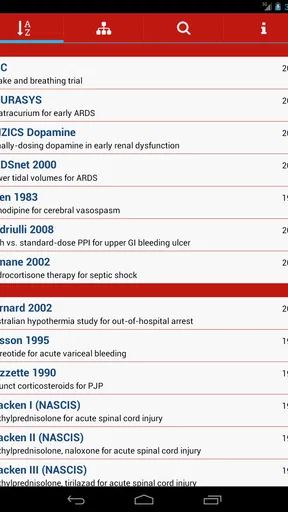
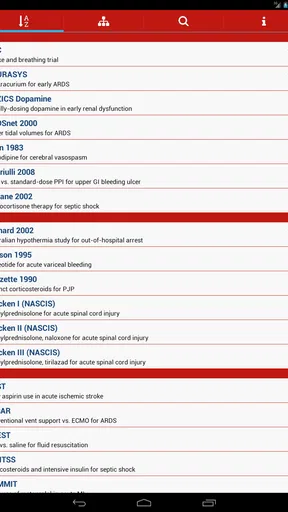
ICU Trials by ClinCalc is a medical reference app designed to help healthcare professionals review important clinical trials related to intensive care medicine. It presents concise summaries of landmark and influential ICU studies, making it easier to check study objectives, patient populations, interventions, outcomes, and conclusions while working, studying, or preparing for clinical discussions.
Who should use the ICU Trials app?
The app is primarily intended for physicians, residents, fellows, pharmacists, nurses, medical students, and other healthcare professionals interested in critical care evidence. It can also be useful for researchers and educators who need a quick overview of major ICU literature. However, it should be treated as an educational reference rather than a substitute for clinical training, institutional protocols, or professional judgment.
Does ICU Trials provide complete research papers and medical advice?
ICU Trials generally focuses on practical summaries and key findings rather than replacing the full text of every original publication. Users should consult the cited study, current guidelines, and additional evidence when making decisions. The app does not provide personalized medical advice, diagnose patients, or determine treatment plans, so clinical decisions must always consider the individual patient and qualified medical supervision.
Can ICU Trials be used without an internet connection?
Availability of offline access may depend on the app version, device, and how its content is delivered. Some reference information may remain accessible after installation, while links, updates, or external study details may require an internet connection. Before relying on it in a hospital or travel setting, open the app in offline mode and verify which trial summaries and features are still available.
Is ICU Trials by ClinCalc a replacement for current ICU guidelines?
No. The app is best viewed as a convenient evidence-review tool, not as a replacement for current guidelines, local protocols, drug references, or consultation with an intensivist and other qualified professionals. Clinical trials can become outdated, have limitations, or apply only to specific patient groups. Always confirm important findings against the original publication and the latest trusted recommendations before applying them.


